

Before you read: If this piece speaks to you, please take a moment to leave a comment, share it with someone who might need to read it, or tap the heart button. These small actions help more women find these conversations about the realities we’re often told to hide.
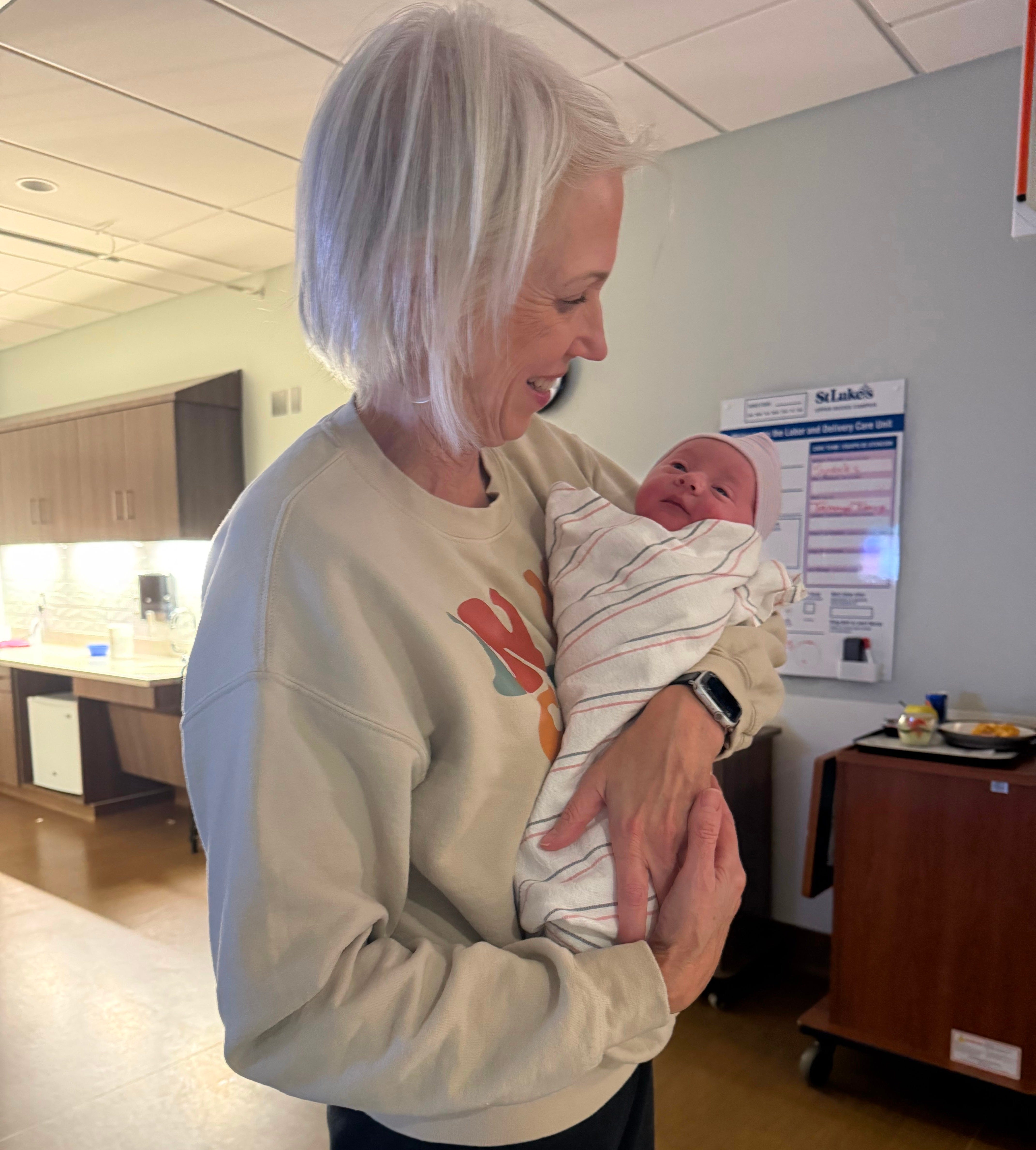
Holding him felt like something that was only slightly denser than air.
A week ago today, baby Hayes joined the family. He was born in the afternoon, so I took his older brother and sister to meet him that evening. I studied Hayes’s angelic face for recognition. Was he more like his mother or his father? I concluded he resembled my bachelor grand-uncle Willi, with his signature lack of eyebrows and hair.
My daughter looked no worse for wear. Hayes was her smallest baby yet, a mere 7 lb. 14 oz. Three pushes, and he was out. She smiled as she sat on one of those large absorbent pads the hospital gives you after you give birth. It peeked out from under her, so I adjusted the blanket to cover it.
Why did I do that?
My 10-year-old granddaughter probably hadn’t noticed it sticking out. If she had pointed it out, it would have been appropriate to reveal details about the birthing process. As it was, she was curious about the clamp on the baby’s belly button, and I explained that he had been attached to his mother only a few hours earlier, just as she had once been.
My 2-year-old grandson only focused on the doctor’s stool, a wonder with its spinning seat and wheel rollers, to a boy obsessed with monster trucks.
Was blood such terrible evidence of what had just gone down?
It bothered me that I wanted to hide it. I realized it’s part of my training as a woman. We’re supposed to have the baby, but then go about our sterile business. Pretend that we didn’t just push out our insides and finally a full-sized baby human. Birthing calls for a whole lot of guts that ends in a profound moment of glory.
The day after seeing the new baby, I happened to see Esther Strauss’s sculpture with the Mother of God sitting on a rock in active labor. The sculpture named “Crowning” depicts the Virgin Mary with a halo circling her head, her legs spread wide, preparing to give birth, the same way actual women do.
The sculpture’s presence in the Mariendom Cathedral in Linz, Austria, created such an uproar among conservative Catholics that they demanded it be taken down. When the Linz diocese did not comply, someone decapitated her haloed head from her body. The unknown vandal has since been crowned the “Hero of Linz.” (See photo of the piece here.)
I remember how much shame I felt that first time I leaked blood on my way to the bathroom after giving birth. I was so horrified that I went back to get a tissue to wipe up the trail. Later, bathrooms became my hiding place where I would breastfeed my child so that I wasn’t exposing my breasts in public. I remember my mother asking why I was feeding my baby in a stall with the question, “Is it really so bad?”
Yes, apparently it was.
A woman’s body feeding a child was obscene, but a woman’s body sold to sell beer was everywhere. We’ve been taught that our bodies exist for display and desire, not for the messy, magnificent work of creating and sustaining life. Breasts are fine as long as they’re decorative. Blood and milk and the raw power of birth? Hide that away.
As each new grandchild enters the world, I revisit my own birth experiences. The first one held the wonder of a science experiment, the second—with no pain meds—was like slipping a banana out of a peel, and the third more like an exorcism. A nurse pressed down on my abdomen with such force I screamed for her to stop. No one explained why that was happening, but the next horror came as the doctor used a vacuum and forceps to pull my baby out. My body became an obstacle between them and the baby, something to be managed and overcome. That last birth was traumatic for both me and my son.
Yet all three resulted in the miraculous gift of life.
Since then, some things have changed for the better. Pregnant women wear form-fitting clothes that celebrate their growing bellies instead of hiding them. Fathers sleep in hospital rooms on fold-out beds, partners in the process. My daughters talk openly about their postpartum experiences including the clots, the overwhelm, the profound exhaustion, in ways I never could. After my births, it was business as usual. No downtime, no permission to name what my body had just been through.
We’re inching toward honoring the full reality of birth and recovery. But as the beheaded Mary in Austria shows us, we still have far to go. We’ll celebrate the bump and the baby, but the blood, the spreading, the raw animal power of a body opening to let life through? That we still want to hide. That we still call obscene.
All mothers deserve halos, deserve to be crowned for the holy work their bodies do, not separated from their laboring bodies, but precisely because of them.
Beautifully stated — the reality of motherhood ! How fortunate your children are to have you as their mom, and how lucky you are to be a grand mother. You should repost this piece on Mother’s Day as a reminder to all.
First of all, congratulations! Secondly, you are so right about this subject! I remember feeling a lot of shame about what was happening to my body in the weeks and even months after giving birth. When friends would stop by, my anxiety was through the roof. I couldn't fit into my clothes and couldn't control when my milk came in, etc. What cultures do to us is so strange to me.