


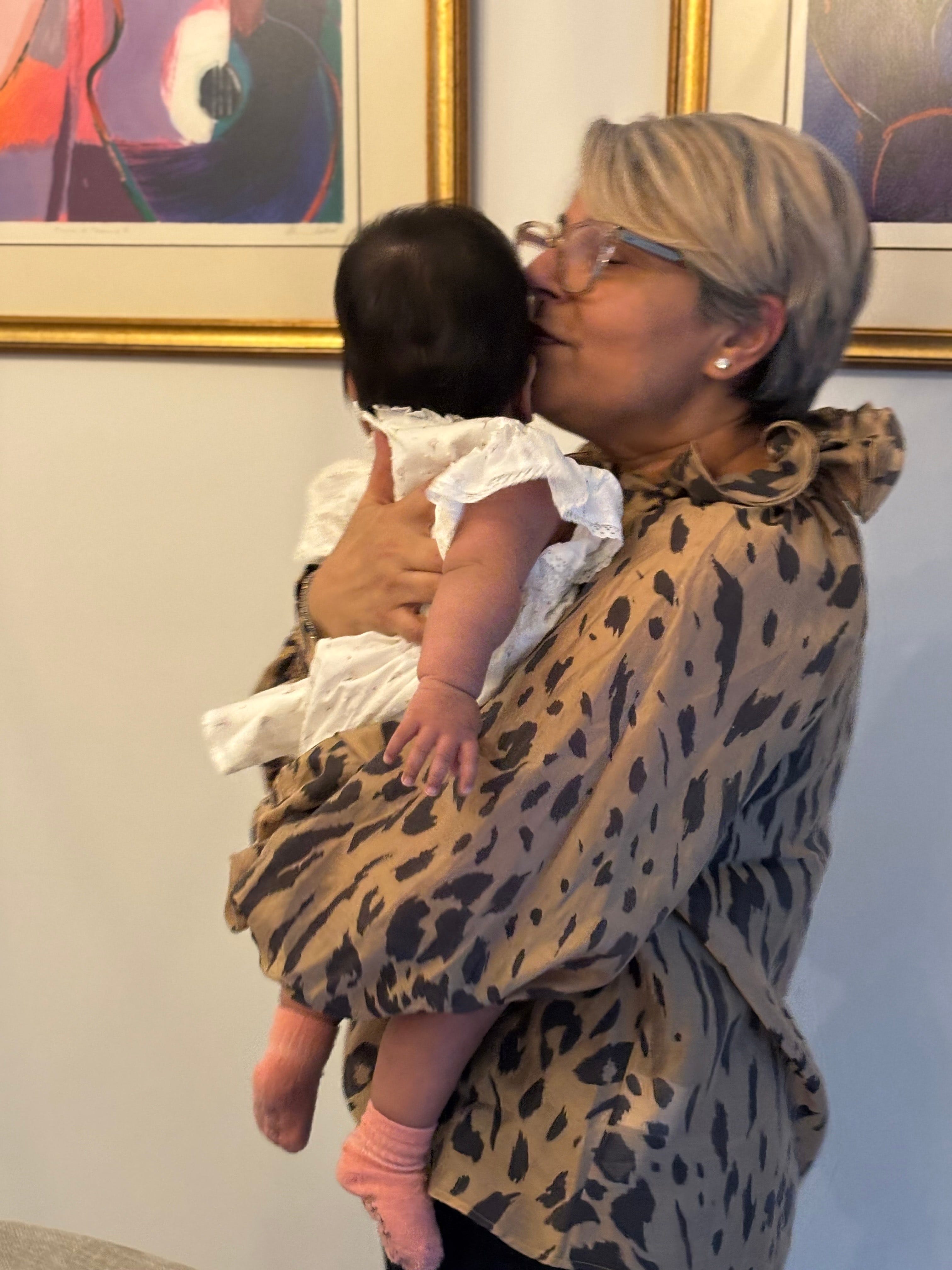
Today’s guest post comes from Savira Gupta, a yoga teacher and writer whose work explores the intersection of ancient wisdom and modern life. This post coincides with a precious time for me. As I write this, I’m with my grandson Julian, while his parents are at the hospital welcoming his new sibling, Archer. This makes the timing of Savira’s piece feel almost prophetic.
When she shared with me how becoming a long-distance grandmother transformed her understanding of what yoga actually means—not just poses on a mat, but a way of being with love, loss, and letting go—I knew you’d want to hear her story.
If her words resonate with you, please let Savira know in the comments, and consider restacking this post so others navigating their own tender moments can find it too.
There are moments when words fall short, because what I feel is nothing but pure love—a connection to a little being who, in her own indirect yet undeniable way, is a part of me. Watching my granddaughter explore the world through her own eyes feels like witnessing something extraordinary: pure joy, pure love, pure presence. She radiates all of it effortlessly. And when I see it, feel it, and connect with it, something inside me softens and opens.
This, to me, is what yoga has taught me to recognize—this return to presence, this tender reflection of love.
What Yoga Really Is
You might think of yoga as exercise—people on mats doing poses and breathing exercises. And while that’s part of it, yoga is actually an ancient practice of training our awareness. It comes from a Sanskrit word meaning “union”—the bringing together of body, mind, and spirit. Those poses and breathing techniques? They’re tools that help us learn to be present, to notice our thoughts and feelings without being swept away by them.
Yoga is really about how we live, how we show up in each moment of our lives. It’s about seeing clearly, feeling deeply, and holding everything—the joy and the sorrow—with an open heart. And nowhere has this become more clear to me than in becoming a grandmother who lives far from her family.
Children are our greatest teachers. They haven’t yet learned to live anywhere but here, now. When my granddaughter laughs, she laughs with her whole body. When she discovers something new—a leaf, a shadow, the feeling of water on her hands—she is completely absorbed. There is no past, no future, only this miraculous present moment.
This is what yoga asks of us. Not to become perfect, but to return again and again to now. To this breath. This moment. This experience of being alive.
Standing Where My Parents Once Stood
But here’s what I’ve been learning about being a grandparent who lives far away: there are also the goodbyes. And each goodbye has taught me something profound about love and letting go.
I remember being the daughter my parents left behind, watching them go with a heaviness in their hearts. And now I stand on the other side of that story, the one who leaves her children and granddaughter.
In this, I’ve come to recognize something deeply ancestral: a full circle that always takes us back to our parents, our grandparents, and even further to those who came before. The challenges we face, the love we feel, the choices we make—all of this has been lived before. Our parents knew this terrain.
Their parents did too.
Feeling Without Clinging
The Bhagavad Gita offers us this wisdom:
“The contact of the senses with their objects gives rise to cold and heat, pleasure and pain. They come and go and are impermanent; endure them.”
What does this mean for us? It means that all feelings—the warmth of holding my granddaughter, the ache when I have to leave, the joy of watching her grow, the longing when I’m far away—all of these are natural, temporary, and meant to be felt.
Not avoided. Not suppressed. But also not clung to so tightly that they define us.
I can enjoy the precious time with my family, feel the tug of leaving, even cry as I go, yet not be bound by attachment. This is one of yoga’s most liberating teachings: we can feel everything fully without being imprisoned by our feelings.
We can love deeply without needing to possess or control.
The Forest Dweller Stage
In the yogic tradition, life is understood in stages. The stage I find myself in now is called Vanaprastha—”forest dweller”; but I like to call it the “grandparenting stage.”
After we’ve spent our earlier years raising families and being at the center of activity, comes this gentler stage of loosening, of turning inward, of shifting from constant doing to simply being.
As a grandparent, this stage offers beautiful guidance. I’m no longer the one making the daily decisions or directing the show. That’s my children’s role now. My role is to support, to witness, to offer love without interference. To be fully present when I’m there, and to trust when I’m not.
The Gita reminds me:
“You have a right to perform your prescribed duty, but you are not entitled to the fruits of action.”
I can show up, offer my love, share my wisdom when asked, and then release any attachment to how things unfold. My children will parent in their own way. My granddaughter will grow on her own unique path. And that’s exactly as it should be.
Yoga Is How We Show Up
This is how yoga filters through every aspect of our lives.
When I watch my granddaughter, I’m practicing presence.
When I say goodbye, I’m practicing non-attachment.
When I watch my children parent, I’m practicing surrender.
When I feel the grief of distance and don’t push it away, I’m practicing acceptance.
This is yoga. All of it.
Non-attachment doesn’t mean we don’t care or don’t love. It means we love fully while holding lightly. It means we recognize that the people we love are not ours to possess. They have their own paths, their own lives, their own lessons to learn.
When I leave my granddaughter now, I do so with gratitude. Gratitude for the time we had. Gratitude for the technology that lets us stay connected. Gratitude for my own parents, who showed me this path even when I didn’t understand it yet.
I recognize that this rhythm of coming together and parting is part of the lineage we inherit, live, and eventually pass on. It’s a reminder that love can be deep, connection can be real, and yet freedom from attachment remains possible.
This is the gift of yoga. This is what we practice on our mats so we can live it everywhere else—in the hellos and the goodbyes, in the presence and the distance, in the holding on and the letting go.
An Invitation
If you’re navigating your own transitions—whether it’s becoming a grandparent, letting your children go, or simply learning how to hold life more lightly—I hope something here speaks to you. Your practice is not just on the mat. Your practice is everywhere.
The ancient wisdom reminds us: feel everything, cling to nothing. Love deeply, hold lightly. Show up fully, then let go.
This is yoga. This is life. And we’re all learning together, one breath, one moment, one precious goodbye and hello at a time.
With love and gratitude,
Savira Gupta
Ilona Goanos, Savira Gupta: First, I LOVE the Brihadaranyaka Upanishad, the Chandogya Upanishad, the Bhagavad-Gita, the teachings of Shankara-charya (Advaita).
NOT SECOND: "Children are our greatest teachers. They haven’t yet learned to live anywhere but here, now. When my granddaughter laughs, she laughs with her whole body. When she discovers something new—a leaf, a shadow, the feeling of water on her hands—she is completely absorbed. There is no past, no future, only this miraculous present moment."
This is the spirit of the artist, Vincent van Gogh or Georges Seurat, depicted so truly and vividly by Stephen Sondheim and James Lapine, "Summer in the Park with Georges". SEE:
https://www.dailyartmagazine.com/sunday-la-grande-jatte-georges-seurat/
Children start life with the real spirituality which they teach us and which the best of us try to recapture.
As of January First, my youngest grandchild was 14.
As of the next day, Nancy and I were blessed with a beautiful newborn.
A child is the best gift of all.
A child is exactly perfect in the way Mother Nature makes her or him.
A child brings so much wonder, beauty, joy.
My favorite line: "I can show up, offer my love, share my wisdom when asked, and then release any attachment to how things unfold." As a practitioner and giver of yoga, I personally have been working on non-attachment. It is hard to do but also can be very freeing. Thank you Ilona and Savira for your work.