

If this piece resonates with you, I'd love to know. Leave a comment, tap the like button, or share it with someone who might need it — someone who maybe hasn't thought about their Mrs. Gallucci in a while.
Suddenly, I’m a person with strategies.
The weekend officially starts on Thursday now because that’s the day estate sales begin. It’s important to get there early on the first day for a chance at the most coveted items, but seasoned buyers know it’s the final hours when you can get the best deals.
I like to think of myself as both disciplined and opportunistic — a dangerous combination in a house full of other people’s things.
There were only a few hours left when I find myself on the second floor with a stuffed brown and white horse under my arm. Seven silk scarves lay scattered on the bed. Not the Chanel ones — they had gone first — but the less bougie ones. I examine each one, since I am bougie myself, only taking the ones marked 100% silk. After all, I’m a businesswoman, not just an admirer of beautiful things. (Though, to be clear, I excel at both.)
I have an eBay store to stock, but my goal is not to bring too much home for myself. I don’t want my kids to be forced to clear it all out one day, standing over a pile saying, “What exactly was Mom doing?” This strategy is not working out well now that I haunt estate sales every weekend like a well-dressed trespasser with exquisite taste.
The bedroom echoes with its bare walls and floor. I remind myself to look around, really look, because the best stuff isn’t shouty—it never has to be. I step to the bureau and see a two-foot long laminated Union Leader newspaper article from January 1967, with a smaller one, also laminated, nearby. Sandwiched underneath is a report typed on a typewriter, flawless, telegraphing its ancientness on brittle, yellowed paper — from the era when one mistake meant starting the whole page over.
And then the India ink paintings appear.
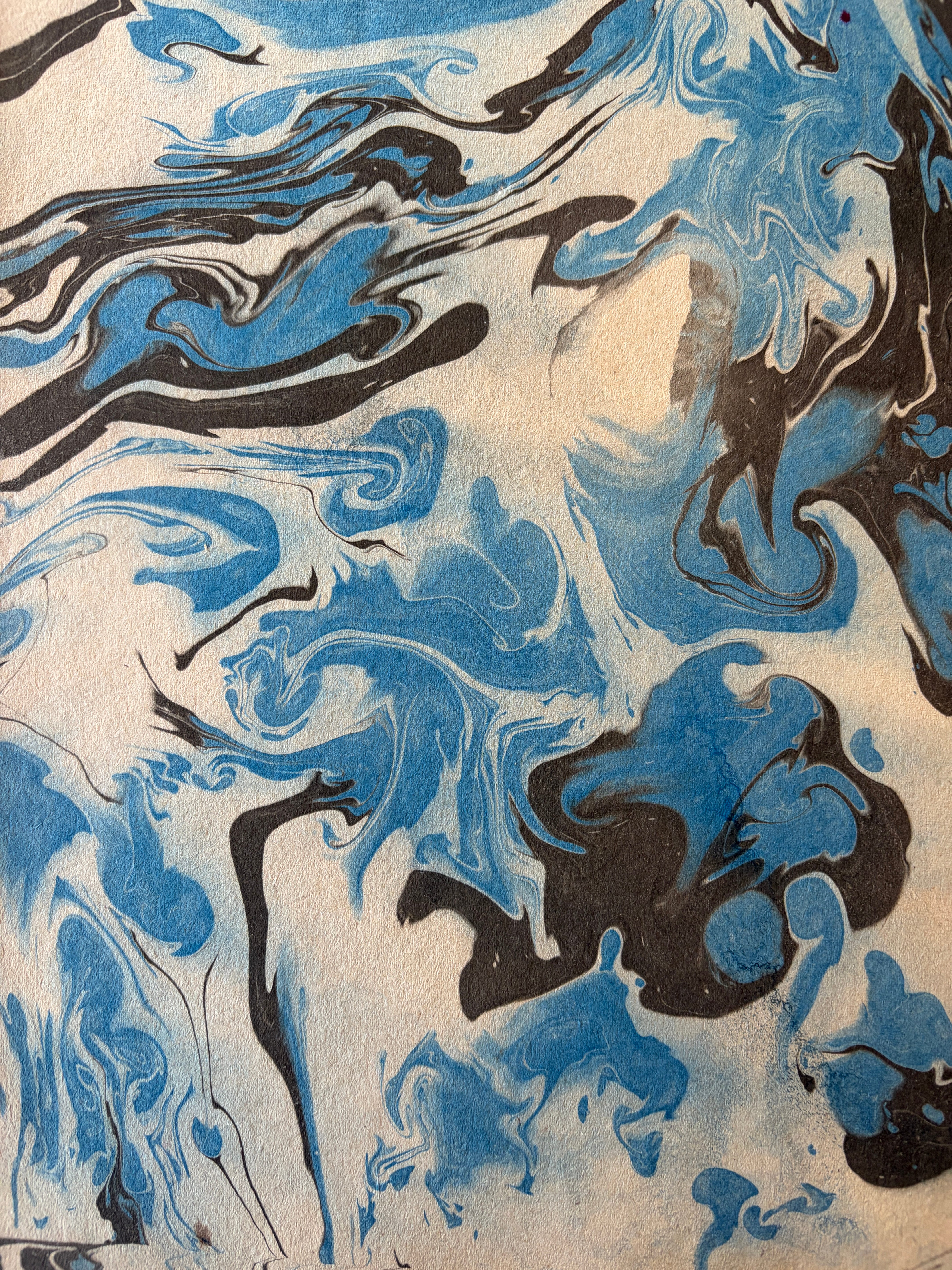
Grainy art paper with swirls of brown, pink, yellow, and blue. Faint staple marks in the corners hint at their time on a classroom bulletin board — high up on the wall, just out of reach for a room full of wiggly third graders.
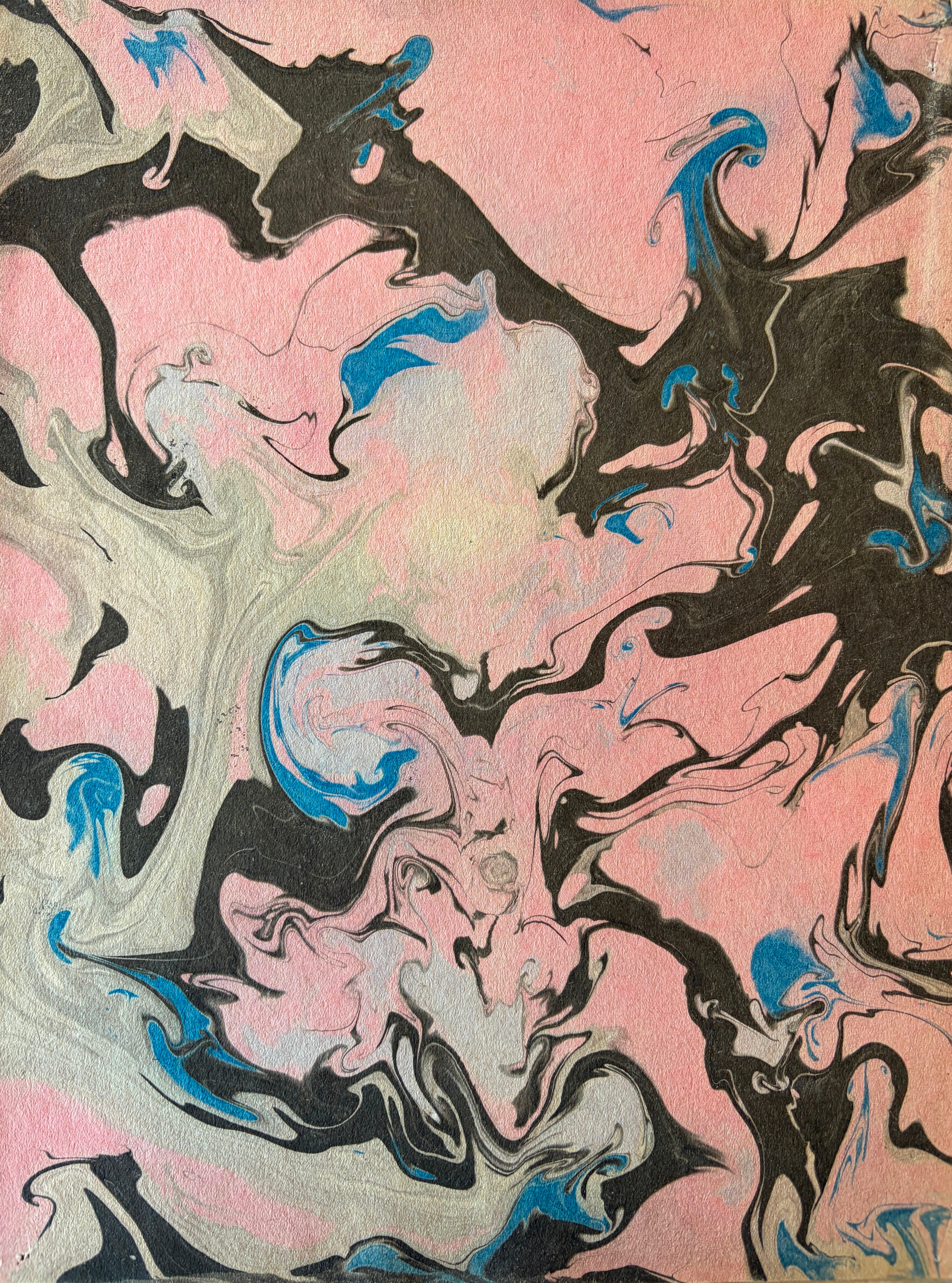
Suddenly I see myself, my chin resting on my desk with a straw between my lips, gathering up all my breath to blow the watery ink across the paper. I’d done this type of painting as a child, too.
I don’t stop to read the articles or the report, but gather all the pieces in my free hand. I have to have this. (A phrase that has never once led to a minimalist lifestyle.)
I pay $5 for mementos from a former third-grade teacher, Mrs. Patricia V. Gallucci, of Battle Hill Elementary School in Union, New Jersey. Less than a latte, more than a small act of faith.
I read her obituary later — she was 91 when she died. In all these years, she never threw away this collection. The family, if there was one left, didn’t want it. Somehow, either Patricia herself or the universe decided it should end up among the lamps and purses and silk scarves for someone to find.
When I get home, I read the newspaper articles about Patricia’s art projects and her own typewritten words. Patricia was not only interested in teaching her students about the process of making unique designs using colored India ink and water. She wanted them to discover the joy of seeing LIFE — she capitalized the word — in the pictures.
Her students reported seeing clouds, rivers, and even Abraham Lincoln with a curl in his hair. Some wrote that they saw poetry. At the end, Patricia notes: “This type of activity provided the opportunity for each child to use his individual creativeness.”
Before Individual Educational Plans (IEPs) existed, before differentiated learning had a name, Patricia Gallucci was already doing it. She put ink in water, let every child breathe on it differently, move it differently, and then asked each one to look and say what they saw. Not the right answer. Their own vision.
I had a teacher like Patricia, too. Mine was named Miss France. I remember her being soft spoken and kind, a rarity in a strict Catholic school with rowdy classrooms of 40 or more students, the educational equivalent of crowd control with a stiff ruler.
In third grade, Miss France had us memorize Joyce Kilmer’s poem called “Trees.”
I think that I shall never see
A poem lovely as a tree.
A tree whose hungry mouth is prest
Against the earth’s sweet flowing breast;
A tree that looks at God all day,
And lifts her leafy arms to pray;
A tree that may in summer wear
A nest of robins in her hair;
Upon whose bosom snow has lain;
Who intimately lives with rain.
Poems are made by fools like me,
But only God can make a tree.
Miss France taught me to see the sacredness of an ordinary tree. Trees, in all their glory, aren’t shouty either, and yet, somehow, they hold the entire sky.
Life came at me with its brutal demands, and those early sparks got buried, not extinguished, just filed under “later,” where so many important things go. I’m sure you had a Miss France too — someone who pointed you toward beauty before the world got loud. Maybe you’ve forgotten her name. Maybe you’ve forgotten what she showed you.
That’s why it matters to have people like Jenny Santa Maria in your life as an adult. Jenny is a pysanky egg artist and a former special education teacher who spent her career devising ways to reach children that the standard approach couldn’t reach. Jenny is the kind of person who refuses to accept that there is only one door in.
During our recent Substack Live conversation, we considered how different the world would be if every child had an IEP.
What if every child had someone who found the particular way they see?
Patricia did that in 1967. Miss France was doing it in 1969 with a poem. Jenny does it today with wax and dye and eggs that reveal themselves layer by layer.
There is a saying that every person dies twice — once when they stop breathing, and a second time when their name is spoken for the last time.
Patricia kept her typewritten report for sixty years. She laminated the newspaper articles. She kept the evidence of what she had done and why it mattered. And now her name is in this essay, which means you just said it too, at least in your mind.
Patricia V. Gallucci taught children to see LIFE in the chaos of ink and water. Miss France put a poem in my body that I still carry. Jenny Santa Maria is still out there coaching adults, mostly women, to see what’s already there, layer by layer.
I'm doing my own version of it — writing it down, keeping the record, trying to point people toward what they might have forgotten they could see.
I don’t know yet whether what I’m building will last. I don’t know if anyone will want it when I’m gone. But I’m writing it down anyway. I’m keeping the evidence. After all — someone always comes in the final hours.
In case you missed it, here is the Substack Live from Monday.
I think a lot about neurodivergence and how hard this is for teachers (and, of course, students). I have a daughter who struggled through school and was in special ed until she took herself out in high school, but went on to get her master's and become a teacher herself. I have a grandson with autism (he's brilliant), and I have been told I am neurodivergent myself. The women you wrote about are heroes in my book. Interesting, I was thinking about trees five minutes before I opened my laptop this morning. I saw a photograph of the most beautiful 200-year-old oak tree in Europe. If you ask anyone who knows me to name the things I love most, TREES is at the top of the list. I read the other day that J.R.R. Tolkien also held them at the utmost highest of his own list of loves, and that's why the Ents appear in TLOTR. Walking, talking trees! They do communicate, that we know. There is so much in this piece that I loved, Ilona.
I was a little distracted in the beginning. I couldn't catch the connections and was reading but not understanding. However, it was engaging enough, I kept on going. Soon I began to get the picture. I'm better for having read it! There is a Japanese Maple outside across the street from my living room window. When I first got here 16 and a half years ago, I hardly noticed it. Then I sort of noticed it lost it leaves and then they came back. Then I noticed exactly when the leaves started dropping, and the buds started popping. Then I figured that the climate issues were swerving it because one year the process happened half a month later. This year I looked forward to its barrenness so I could see farther in the distance. The buds returned even more quickly this year. It's funny what details catch up when they do! Thank you for writing about these wonderful women who took seriously the creative impetus in many who don't get nourished or encouraged often enough when that which is drastic and necessary grasps our energy and yanks our neck, constantly.