

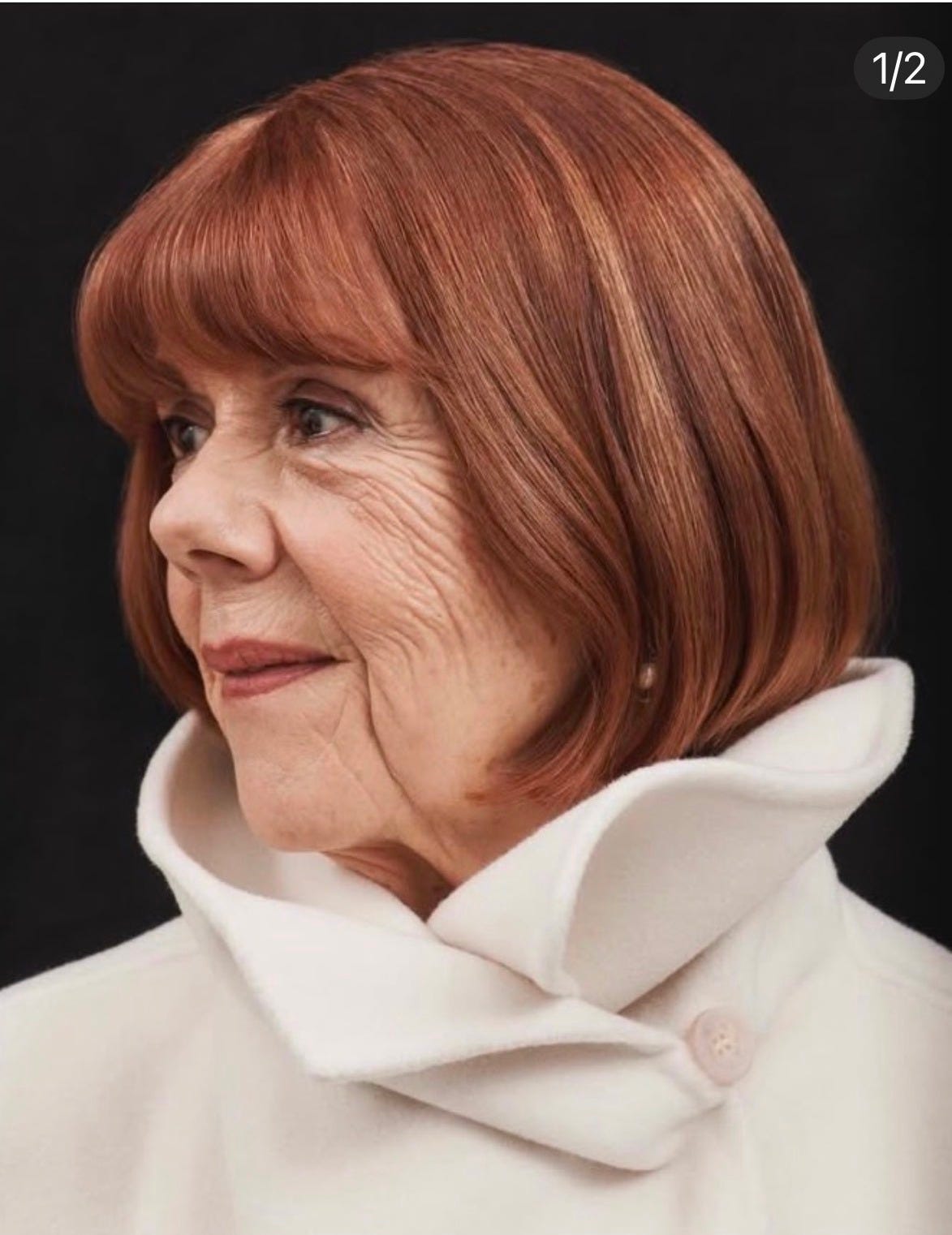
There’s a scene in Gisèle Pelicot’s memoir that I can’t shake. In the early days after her husband’s arrest, before she fully digested the scope of what he had done to her, she went to the prison and brought him a bag of warm clothes. She was worried he might be cold.
I know that woman.
I was that woman.
I had those same feelings for a man who had only been physically present for most of our marriage. When he spoke of us in conversation as “We decided…” “We went…” I would feel validated for that moment when he considered me a part of him.
I took care of him, even though he offered little in return. I shopped, cooked, cleaned, and took care of our children. I worked a full-time career.
The worst part?
I enjoyed taking care of him. It gave me a role in his life. He got the best I had because that’s who I was trained to be.
I don’t know exactly when my dissatisfaction crescendoed. It was a series of cracks, not a single break.
A set of books that reminded me I was capable of longing.
A LinkedIn message I almost didn’t send.
A friend who asked me one question that undid twenty years of certainty.
And somewhere in the middle of all of it, I lost twenty pounds — and my husband never noticed I was disappearing.
When Gisèle decided to open her trial to the public, she did something I hadn’t yet learned to do.
She refused to protect everyone else from her truth. But truth in a woman's mouth is rarely received as simply true.
Because of its complexity, it is often not clear to those on the outside. Others deliberately distort it. Mostly, people enjoy being uninformed — seeing only headlines, hearing only whispers — and their understanding of a few “facts” is colored by their own lens and desire to be right.
Gisèle knew opening the trial could go sideways. It did. Her husband, Dominique, had videotaped every assault. She was comatose in the footage. That’s some rock-solid evidence.
Gisèle even fought for the footage to be shown publicly so no one could claim ignorance about what rape actually looks like.
She won that fight. And then the court reversed the decision and locked the public out anyway.
Those images alone should have been enough to convict them.
They weren’t.
One defense attorney pointed to the rhythmic movement of Gisèle’s hips during an assault and told the court she was enjoying it. A drugged, unconscious woman’s involuntary physical response was used as evidence of her consent.
Her own body, turned against her.
As women, we’ve learned our truth is only for us. For the outside world, it is negotiable when coming up against men, especially wealthy, powerful, and connected men.
But who am I kidding? It’s the same with ordinary men in our lives, even though they have slightly less leverage than the Jeffrey Epsteins of the world.
When I left my marriage, people assumed I had been having an affair, and that’s how they treated me.
One day, I stopped at my neighbor’s house, two doors down from our family home. This was the woman I saw every week when we used to drive our kids to school together. We knew each other well. But this time when I knocked, she didn’t welcome me in. Instead, I stood on the stoop and spoke. I got the hint and left.
After my husband and I split, I still looked to my church community for support. When I shared with my parish pastor everything that had happened, I was looking for a lifeline — some hope that I hadn’t ruined my life and my family’s. He assured me it was all my fault, and Larry’s too, confirming what I had already thought.
Great support, Father.
At an outdoor fair that summer, a man who was also a Eucharistic Minister looked through me when I spoke to him. It was as if I wasn’t even there.
I continued to attend church, with no interaction from anyone except one woman who had recently gotten divorced. She offered kind words, which were unexpected, and I fell apart before her. She told me it would be okay, although I couldn’t imagine how.
My own parents cut ties with me. My mother’s words haunt me still. “I am ashamed of you.”
I was tried in whispers, convicted without a courtroom.
Virginia Giuffre didn’t even get that much mercy.
Virginia was sixteen when Jeffrey Epstein first trafficked her. For years she told her story to journalists, to lawyers, to anyone who would listen. She named powerful men. She was specific. She was persistent. And for years, the world found reasons not to believe her.
She was too young, too damaged, too inconvenient. The men she accused were too wealthy, too connected, too important to be brought down by one woman’s testimony.
Andrew Mountbatten-Windsor, the man she accused of assaulting her when she was a teenager, was only arrested this past February, not for what he did to Virginia, but for sharing government secrets with Epstein. The system that had ignored her for decades finally moved, and it moved for paperwork.
Virginia Giuffre died by suicide in 2025. She did not live to see it.
She told the truth her entire adult life, and the truth was not enough. The truth is never enough when the world has decided in advance that a woman’s account of her own experience is negotiable.
This is what we are up against. Not just monsters like Dominique Pelicot or Jeffrey Epstein. But the everyday machinery that turns women’s testimony into something that can be bargained with, dismissed, or simply ignored until we are no longer here to repeat it.
Let’s always remember Virginia Giuffre and the price she paid.
Gisèle Pelicot survived the assaults, opened her trial to the world, and published her memoir. She is prospering now with a new partner, her children, her grandchildren, and her voice fully her own. Her book is called A Hymn to Life. The title is not ironic. She means it.
I too found a new life with my husband Larry. I outlasted my parents’, my neighbor’s, and my priest’s judgment. I write about it.
I don’t know how to make this hopeful. What I know is that Gisèle Pelicot is still here. I am still here. And we are both, finally, telling our own stories.
Writing this one cost me something. If it cost you something to read it, I'd love to hear about it in the comments. And if you know a woman who is carrying shame that was never hers to begin with — please send this to her.
PS My Substack Live with Jenny Santa Maria, the Pysanky Egg Artist and Art Coach is postponed. It will now be on Monday, March 23rd at 11 a.m. I’ll send you a reminder next week.
I can only imagine how writing a piece like this could make you feel like you’ve been beaten up in a boxing ring. I’m glad that you brought up women as well as men being predatory and judgmental because women can do unbelievable harm to other women, and you got to experience their judgments first hand, unfortunately. When you moved on from your first marriage your very actions probably caused existential threats to other people who were unhappy and not knowing how to move forward. For many people, it is much easier to attack than allow themselves to feel empathy and be inspired. The last few lines about hope are a reminder that you did win. You did! You are living life on your terms with your people, creating and contributing, doing your yoga and your retreats, growing flowers, holding and kissing babies and your own kids, writing your truth, and loving so many. If that’s not hopeful, I don’t know what is. On top of it all, you found a man who has the precious and rare gift of humor and laughter. He literally does magic tricks! Of all the many things you could’ve sought out in the second marriage, you received this wonderful dimension in your life. It sounds like in the first chapter there was a lot of duty and in that constant service we are rarely laughing. Just thinking about your life with LG now makes me smile and laugh.
God, Ilona, what can I say? Just because my gender, age, whatever prevents me from knowing your perspective, it doesn’t mean I don’t feel your emotional pain that just reaches out of these pages and overwhelms me. I’m so sorry for all of that you endured. My reaction to what you wrote was OMG, what’s wrong with these people?!? I may not understand how a woman feels, her fights and trials, but you only have to fall back on your own humanity to extend kindness, compassion and even understanding. Thank you for trying to yank these tired old man’s eyes open. I so enjoy your writing, thank you!