

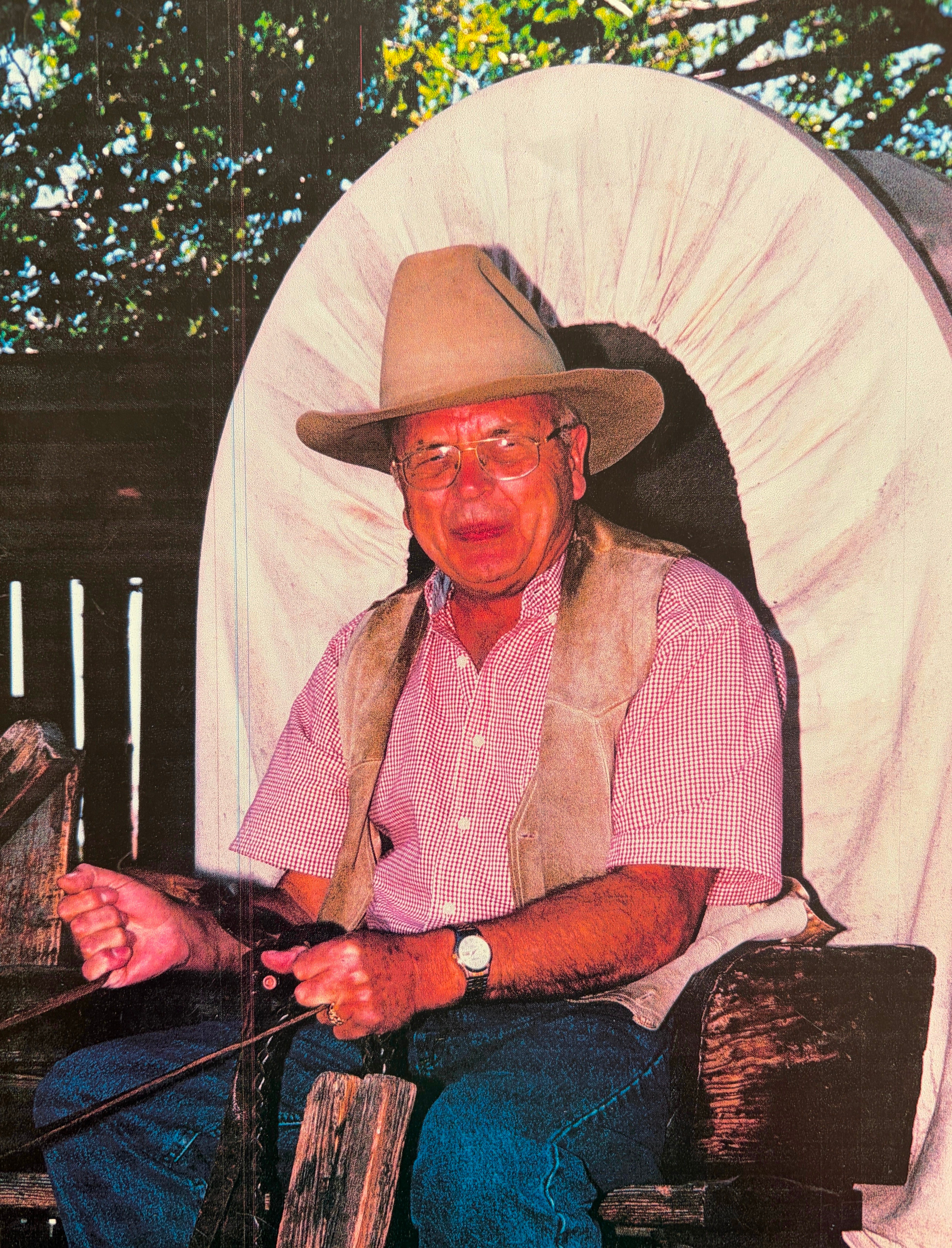
My dad was the fastest gun in the West.
This is the photo of him somewhere in the New Mexico, wearing a cowboy hat, holding the reins of a horse, looking like a man who would never wait around for anything.
And he didn’t.
If my mom gave him a honey-do list, he finished it before the ink dried. There was no lollygagging. He was all action, no matter what you asked.
Except.
There is always an except, and this one had to do with his health. It’s not like he never went to the doctor. He took care of himself, going for the necessary checkups before my mom became disabled and dementia took control of their lives.
Taking care of her became his sole priority.
This was nothing new, really, as she’d always been his number one concern. Dementia took hold of my mom with a vengeance after surgery to mend a broken bone. My dad blamed himself for what happened to her, and caregiving became his penance. All of his time and attention were dedicated to taking care of my mom.
So when he was told to get some follow-up tests for the spot they saw on his lungs, he was beyond slow. He just never went.
I don’t remember when the coughing started, but it wouldn’t go away. He coughed all the time.
Finally he made the appointment.
He received a stage 4 lung cancer diagnosis in December. The doctor reassured him that there was hope and treatment possibilities. The doctor knew people who were walking around with stage 4 and living fully.
My dad felt confident that would be him, too.
I took care of my mom while my dad went to the hospital down the street for chemotherapy.
More and more though, he struggled to breathe, and it became clear one Friday in early March that the treatments weren’t working. A visiting nurse told me that the oncologist was admitting my father to the hospital.
The doctor was blunt about it. “You will not be going home again.”
He told me that my dad had only a couple more weeks to a month left, a shockingly short and grim life expectancy.
That night, from his hospital bed, he called me.
“Do you think I should get a second opinion?”
This was the same man who had no interest in pursuing one in December when he received the stage 4 diagnosis.
“Dad, I think it’s too late for another opinion.”
I hated saying those words. I hated to give up hope. I hated the thought that he would not be here much longer.
The next morning, his ability to breathe declined precipitously, and the nurses began administering morphine. Before the sun came up on Sunday morning, hospice called to tell me my father didn’t have much longer and to come in right away.
“His skin is mottled.”
The nurse thought those words would explain her urgency. To me, her words made no sense.
This was happening too fast.
Didn’t the doctor say he still had a month left? What does mottling mean anyway? No one had ever taught me the vocabulary of the dying.
I got my mother up and dressed, wheeling her chair through the quiet corridors of the hospital’s hospice unit by 6 a.m. A white blanket covered my father up to his chin. He seemed at peace, in a deep sleep from which there was no rousing him.
Unlike the day before, there was no oxygen mask, no IV, and no heart monitor beeping. His breathing was loud and jagged, with long pauses between breaths. The sound reminded me of the nights I used to clamp my pillow over my head because he snored so loudly from their bedroom across the hall.
Now it seemed like he was gasping. Sometimes I wondered if he might take another breath, but then he eventually would.
I had positioned my mother next to his bedside right near his head, but she didn’t seem to understand why we were there or who it was laboring to breathe in the bed next to her.
We were in the third hour of our vigil when I called my best friend to update her on my family’s situation. Mid-sentence, I noticed a sudden, terrible silence.
My dad had stopped breathing.
He had taken his last inhale while I was talking about him on the phone, and then…nothing.
Why had I thought I had the luxury of a few minutes to talk on the phone?
I thought I had time.
Deep down, I hadn’t imagined that he would actually die. Or that there would be no warning — that he could just stop breathing without an announcement or the consideration of allowing me to be ready.
I wasn’t ready.
A nun came in at the moment of my bewilderment. I announced he’s not breathing. Like an irrational child, I hoped she could fix something or tell me the obvious wasn’t true.
She took a stethoscope out of her pocket, placed it on his chest and listened. She turned and told us he was gone.
I looked at my father’s lifeless body. He looked like his old self, except his mouth hung open. I asked her if we should close his mouth. All the people on TV always had their lips pressed together when they died.
Maybe he had done it wrong.
Sister was kind and told me the facts of how real people die. The muscles all relax, including the jaw.
Even though I was in a hospice unit with a man who’d been given a death sentence two days earlier, I was in shock. I never thought my father would die. Not really.
He would never leave me to take care of my mother alone. He knew I wouldn’t do it right, that I couldn’t manage her. That had been his job.
But he was gone, and he had left so quickly. No two weeks languishing in a hospital. When he realized he was dying, he did it like he did everything — quick and in a hurry.
The fastest gun in the West, one last time.
I was a 50-year-old woman the day my father died, and I didn’t know what any of it should look like. No one had taught me the vocabulary of dying, or told me there would be no warning, or explained that the body knows how to let go even when the people in the room do not.
My dad held the reins of everything — the house, my mother’s care, every list he was ever handed. And then, without waiting for permission or an audience, he let go of those too.
I think we deserve to know what letting go looks like. Not to be afraid of it, but to stop being surprised by it.
That’s why I’m talking to Kacie Gikonyo, a death doula, on Substack Live — Tuesday, May 19th at 11 a.m. EST. She will talk about preparing the dying and their families for death, and I want to hear what she knows that no one ever told me. I invite you to join us.
Check Kacie out below.
Mark your calendar and I look forward to seeing you next week.
PS (I will send out a reminder on Monday with the link.)
Death, especially here in the States, is such a mystery, and we are not prepared for it. Even when I knew my mom was dying, I wasn't prepared for it. I think we have protective mechanisms that help us through these times (like you being on the phone, not understanding his time was so close). It's part of the grief process that's called denial. It's a natural phenomenon that helps us process our grief gradually. I still think about some of the things I thought and even said out loud when my mother was dying, and I feel a little foolish and naive, but I also know the "why."
I’m so sorry you went through this without knowing what to expect. Thank you for helping others. ❤️