

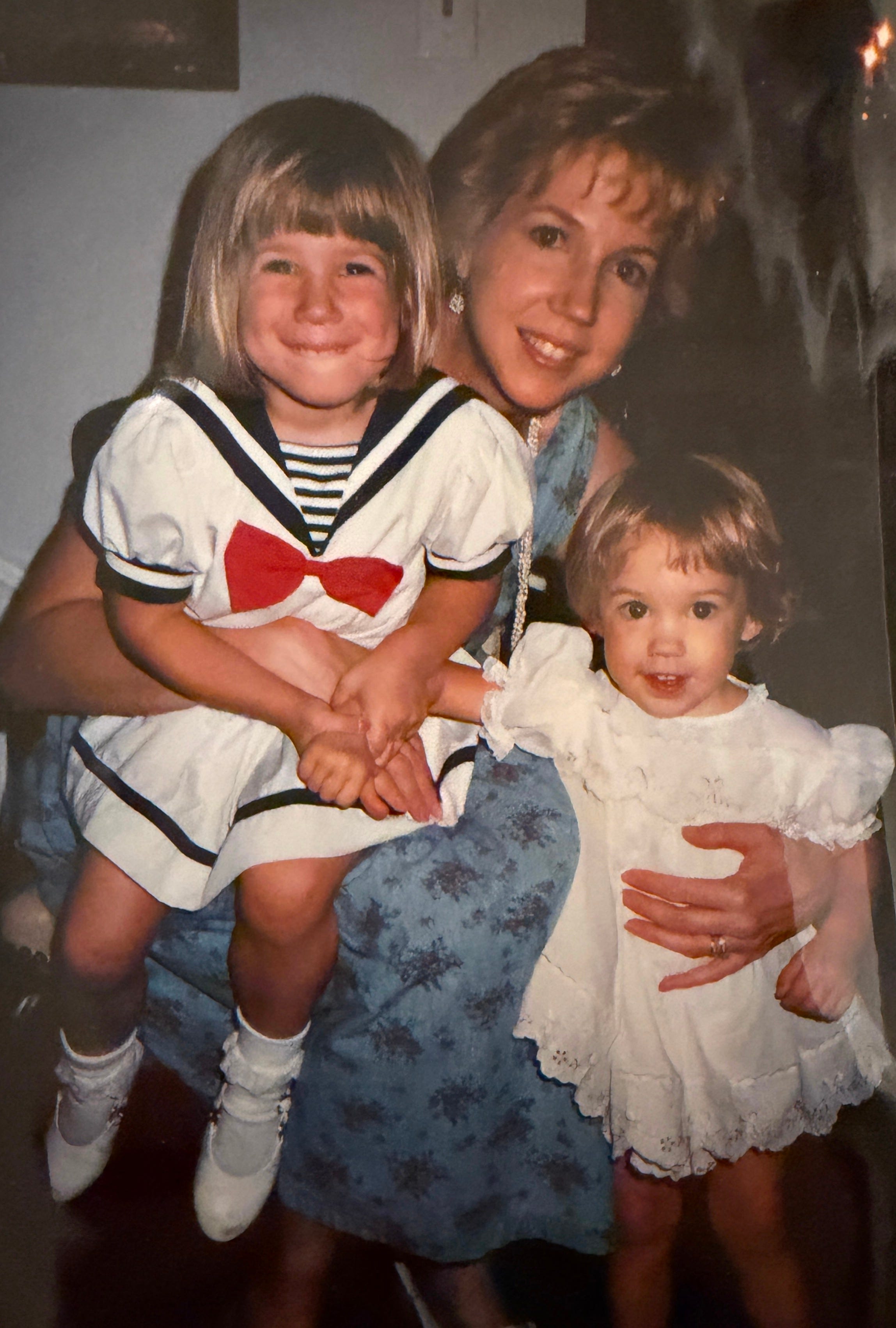
This is the story about how I gave up my autonomy, sense of self, my freedom and instead became enmeshed with the dogma of the Catholic Church for 16 years.
No one forced me to do this. I did this to myself. I’m telling you this not because my story is unique, but because I don’t think I’m the only one.
Early in my marriage, I realized my husband and I were incompatible. The red flags had been there while we were dating. I saw them and looked the other way. They're not the point of this story.
I had already decided he was the one.
I was tired of being single. The love of my life, my boyfriend from college, had gotten away. There was no one who compared to him. I had had steady boyfriends since our break-up, and this relationship checked off important boxes. He provided enough to make a potential marriage work: a good job, steady income, attractive, and he came from a loving blue-collar family much like my own.
We had a lot in common, and fell in love.
I explained away his shortcomings, God knows I had plenty myself. Instead I focused on his positive attributes. I’d already had way too much negativity in my life with my mother’s harsh words and inability to be pleased. She thought all my boyfriends sucked, so it was easy to dismiss her complaints about this one.
Once the dust settled after a whirlwind romance, I found myself married and gave birth to two daughters in quick succession. Despite living in a family of four, I felt inexplicably alone. My spouse was physically there, but he had not woven himself into the emotional fabric of our family.
Our marriage appeared intact from the outside. It was an image we both cultivated and people expected to see.
I had achieved the dream of a suburban home with a white picket fence, but I was the one running things: the bills, the kids, the decisions. He didn’t fight me on it. He just let me. And I mistook that for a partnership.
Financial insecurity made our union worse. We’d bought a house that we had to stretch for and were now saddled with a big monthly mortgage payment. It was difficult making ends meet.
Instead of divorcing, which barely crossed my mind, I took the path of least resistance. I stayed put. Taking note of my situation, I concluded I could no longer trust myself to make important decisions. Clearly, I had settled, and now too much was at stake with two babies for whom I longed to provide the very best.
The church became a logical place to land. The building was a short walk away. We went every Sunday morning, as was my training. My mother did not allow skipping mass. It was a sin after all. I fell away from church during the free-wheeling lifestyle of a college student, but moving home landed me back in a familiar weekly pattern. Every Sunday without fail, we attended mass for the next 16 years. It gave the week its rhythm. It was what I knew.
I didn’t dive deeper into Catholicism right away because mostly I was trying to get through the day with two toddlers. Then my son came along, and my energy stretched across three people who depended on me for everything. For a long time, that was enough. They were the salt of the earth, filling my cup with joy.
As they grew up, the hollowness of the marriage confronted me. I had come up for air and found out there was no ‘there’ there.
My solution was to attend daily mass after the kids got on the bus. I was the youngest in a group of gray-haired folks. If I got there early, I could say the rosary in my pew before mass started. It comforted me to be in the church’s quiet. I thought it was God who drew me there. He saw me. He could fix this.
I journaled during this time, and when I read those entries back, I could see how despondent I was. I begged God to heal my husband. To make him come back to us. Even though his body was there, his mind and heart were not.
The church gave me language for my suffering that made it feel sacred instead of senseless. I wasn’t lonely — I was carrying my cross. I wasn’t trapped — I was honoring my vocation. I wasn’t unhappy — I was being tested.
Once I had those words, I didn’t need my own anymore.
I listened to Catholic AM radio and cassette tapes whenever I could — running errands, folding laundry, waiting in the pickup line. I filled every quiet moment with the church’s voice so there was no room left for my own. I called it studying.
Now I see it for what it was: I was drowning out the doubt. I thought it would be my salvation and the key to staying in my marriage. I would somehow rise above the dysfunction.
I enrolled in a Catholic lay program to take a deep dive into the faith. The pastor had to approve it, and I felt lucky when he did. The course was a series of classes over a couple of years. I had to complete a project for our local church in order to graduate.
I became a Eucharistic minister, and when that wasn’t enough, I became a teacher in the RCIA (Rite of Christian Initiation for Adults), a program for people converting to the faith as adults. I headed a regional Catholic women’s annual retreat called MOM (Mary Our Mother) – Heart of the Home.
I didn’t think of those things as work. I thought of them as service. But I was staffing the church for free — training their new members, standing at their altar, completing a project for the parish just to earn a certificate. The more I gave, the more invested I became, and the harder it was to imagine walking away from everything I’d built.
That’s how it works. They don’t have to lock the door. You lock it yourself.
By then, the church had become the lens through which I saw everything. People outside the faith weren’t just different — they were lost. Ours was the one true faith.
Friends who slept in on Sundays, who questioned doctrine, who trusted themselves over scripture — I pitied them quietly. I didn’t realize that the wall I’d built between us and them was also the wall keeping me in.
The full story of why I left my marriage is one I’ve told before and won’t retell here. What I’ll say is that love came back into my life, and it reminded me what it felt like to be fully seen. That was the jolt. Everything I’d been holding in place started to unravel.
When I finally left, I thought the church would catch me. I’d given it sixteen years. I’d walked to daily mass. I’d trained converts. I’d stood at the altar and placed the Eucharist in people’s hands.
Surely that counted for something.
I went to the pastor. He told me the failure of my marriage was my fault — something I’d set in motion as a reckless twenty-year-old. There was no curiosity. No compassion. Just a verdict.
After that, I was shunned. Not dramatically — no one stood up and pointed. People just stopped talking to me. The women I’d run the retreats with, the ones I’d trained alongside, they looked through me.
I was trouble. I had broken the rules, and the rules were all that held us together. There was no fabric underneath. I’d mistaken structure for love.
I didn’t make a dramatic exit. I just stopped going. It wasn’t a door slamming. It was more like finally putting down something heavy that I’d convinced myself I needed to carry.
What took longer was understanding what those years had actually been. I used to think my time as a Eucharistic minister, an RCIA trainer, a student of the faith — I thought that was devotion.
Now I see it differently.
I was grappling. I was circling the things that never made sense to me, hoping that if I got closer, studied harder, gave more of myself, the belief would finally take root.
Someone once told me, “If it all made sense, what would be there to believe?” And I accepted that. I let it quiet the questions. But the questions never actually stopped.
The truth I couldn’t admit, not to the grannies at daily mass, not to the converts I trained, not even to myself, was that I never fully believed. Not deep down. I gave it lip service. I performed belief the way I performed a happy marriage, convincingly enough that even I almost bought it. And when the belief didn’t come, I did what I’d always done: I blamed myself. If I just studied more. If I just prayed harder. If I were smarter, more faithful, more something, it would click.
That’s the trick, isn’t it? The system tells you that doubt is your deficiency. Not a sign that something doesn’t hold up; rather, a sign that you don’t measure up. And for a woman who had already decided she couldn’t trust her own judgment, that was the perfect trap.
I found the word for what I’d been doing on TikTok, of all places. A woman was talking about religious deconstruction — the process of pulling apart the beliefs you were handed and deciding which ones, if any, are actually yours. I didn’t even know it was a thing. But listening to her, and then to others — atheists, former evangelicals, ex-Catholics — who methodically picked apart the very doctrines I’d been asked to swallow whole, I felt something I hadn’t expected. Not anger. Relief. Someone was finally saying out loud what I had been too ashamed to whisper: this doesn’t make sense, and it’s not because something is wrong with you.
I’m still in that process. I put up a tree every December, not for the birth of Christ, but for the winter solstice — for the pagan roots underneath the story I was told. I keep what I choose to keep. I leave the rest. That’s not rebellion. That’s autonomy. And it’s taken me a very long time to know the difference.
I went through some of those same things when I attended the Catholic Church for seven years. I went through RCIA and baptism and became a Eucharistic Minister. But that's where the church left me. Because I was a former Evangelical, they would not allow me to volunteer in any teaching position. The Evangelicals had turned their backs on me because I became a Catholic. I finally realized (after deconstructing) that although my faith had changed drastically, it was still there. I love the mystery of it now. I no longer need certainty, church attendance, or volunteering, or fear. Great piece, Ilona.
Thank you for sharing your painful and enlightening journey with such honesty here. As a Lutheran pastor, I can assure you you're not alone. The deconstruction work can bring wonder. A saying I appreciate is that the opposite of faith is not doubt, but certainty.